
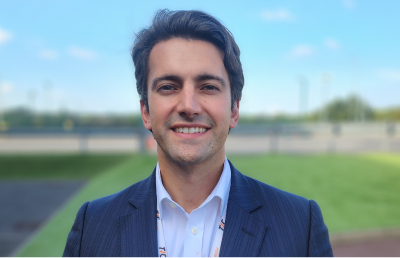
Dr. Christian Kleanthous is a qualified GP with expertise in sports medicine, trauma, orthopaedics, and MSK medicine. Holding a Neuroscience degree from UCL, he’s served as a team doctor across various sports, including FA league football and rugby, and has provided medical support at events like the Rio Olympics and London Marathon.
- Dr. Christian Kleanthous

- Dr. Christian Kleanthous

- Dr. Christian Kleanthous

- Dr. Christian Kleanthous



Disclaimer
This article is for informational purposes only and does not substitute professional medical advice. Please consult your doctor or a qualified healthcare provider before making any decisions about your health or starting any new treatments.A TIC Imaging mobile lung cancer screening unit completed a week in Norwich in June, marking the moment the Norfolk and Waveney programme reached every part of the region for the first time.
The unit, sited at the Tesco Superstore on Ipswich Road, carried out more than 350 scans across the week and is scheduled to return to Norwich in August as part of the rolling deployment.
Commissioned by the Norfolk and Waveney Integrated Care Board and delivered by TIC Imaging in clinical partnership with Norfolk and Norwich University Hospitals NHS Foundation Trust, the programme has now invited more than 12,000 people across the region for a lung health check. Of those who have been scanned, 18 lung cancers have been detected at stage one or stage two, when curative treatment options are widest. A further seven have been detected at stages three and four.
The deployment is part of a national NHS England target to have offered an initial screening to every eligible patient by 2030. NHS England figures released in May showed that more than 10,000 lung cancers have been detected through the national screening programme since 2019, with three quarters caught at stage one or stage two.
A clinical voice on the unit
Chloe Evermore, Lead Cancer Nurse at Norfolk and Norwich University Hospitals NHS Foundation Trust, visited the site during the Norwich week as part of the assessment team.
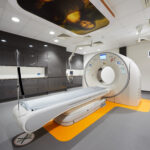
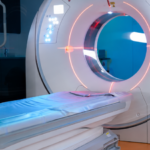
"I see myself as a bridge between TIC and my patients, making sure we keep things smooth and timely," she said. "The unit itself is impressive. It's airy, there's room to work, the technology looks excellent. If I were a patient, I'd be comfortable to have my CT scan in there. It's clean, cool, and everyone's really approachable."
She also drew attention to the low-dose CT capability built into the scanner.
"The low doses mean lower risk of any incidental harm in the future. Clinically that matters a great deal."
A community-based model
The Norfolk and Waveney programme is built around the principle that screening attendance rises when units sit close to where patients already go. Research has shown that uptake is highest when a screening service is within 30 minutes of where eligible patients live, and the supermarket car park model has been responsible for a significant share of the national detection figure.
Mike Hughes, Community Engagement Manager at the Roy Castle Lung Cancer Foundation, who attended the Norwich open day, said the community model is central to closing the gap.
"It's proven to be really important to have a community-based screening programme, especially where people can easily get access to it. People travel into supermarkets regularly. Screening in general is really important. We talk about early diagnosis and saving lives, and that's the key to screening."
The open day was also attended by staff from Norfolk and Norwich University Hospitals NHS Foundation Trust and from the Norfolk and Waveney ICB project team.
The TIC Imaging position
Dr Christian Kleanthous, CEO of TIC Imaging, urged eligible patients to act on their invitation letters.
"It's a fantastic programme but it needs everybody to engage for it to work for the population. If you've been invited to attend lung cancer screening in Norwich, please don't put it off. It really is the difference between life and death."
The unit deployed in Norwich is the MediBence Thunderbird, a relocatable integrated diagnostic unit designed for community deployment. TIC Imaging was the first clinical partner to deploy the Thunderbird.
What happens next
The unit returns to Norwich in August. Current and former smokers aged 55 to 74 living in Norfolk and Waveney will continue to receive invitations through their GP.
Conclusion: Shedding Light on Your Health
Digital X-rays are a remarkable blend of technology and healthcare, offering quick, accurate insights into your body's inner workings. They're vital in diagnosing injuries, monitoring conditions, and guiding treatments—all while keeping you safe with minimal radiation exposure.
Remember, open communication with your healthcare provider is key. Don't hesitate to ask questions or express concerns. After all, your health is a team effort, and you're the most important player.
So the next time you're scheduled for a digital X-ray, you can step into the imaging room with confidence, knowing exactly what's in store. It's not just about seeing your bones—it's about seeing the bigger picture of your well-being.
Resources
- RadiologyInfo.org - Digital Radiography (X-ray)
- Mayo Clinic - X-ray
- American Dental Association - Dental Radiographs (X-rays)
- Centers for Disease Control and Prevention - Radiation and Pregnancy
- U.S. Food & Drug Administration - Reducing Radiation from Medical X-rays
- National Institute of Arthritis and Musculoskeletal and Skin Diseases - Arthritis Imaging Tests
- American Academy of Orthopaedic Surgeons - Imaging and Radiology
- World Health Organization - Ionizing Radiation, Health Effects and Protective Measures
- Johns Hopkins Medicine - X-ray (Radiography)