

Dr. Christian Kleanthous is a qualified GP with expertise in sports medicine, trauma, orthopaedics, and MSK medicine. Holding a Neuroscience degree from UCL, he’s served as a team doctor across various sports, including FA league football and rugby, and has provided medical support at events like the Rio Olympics and London Marathon.
- Dr. Christian Kleanthous

- Dr. Christian Kleanthous

- Dr. Christian Kleanthous

- Dr. Christian Kleanthous

- Dr. Christian Kleanthous




Disclaimer
This article is for informational purposes only and does not substitute professional medical advice. Please consult your doctor or a qualified healthcare provider before making any decisions about your health or starting any new treatments.How long an MRI takes is among the first questions people ask when they've been referred for one. Most scans are shorter than you'd imagine, with the exact length depending on what the radiologist is looking at.
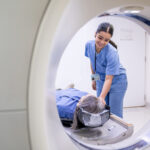
You'll be talked through the scan before it begins, and the team stays with you from start to finish.
MRI scan times by body part
Most MRI scans run between 30 and 60 minutes from the moment the table slides you into the machine to the moment it brings you back out. A knee scan can be done in 20 minutes. For a shoulder, allow around 30 minutes. Brain and spine scans typically take 30 to 45 minutes. Move into the abdomen or pelvis and you are looking at 30 to 90 minutes depending on what the radiologist needs to see. The outlier is a cardiac scan – an MRI of the heart can extend to two hours, but that's partly because the machine has to work around the fact that your heart will not stay still for long enough to be politely photographed.
The type of machine also plays a part. Higher-field scanners can produce the same images in less time – another reason scan durations vary between clinics.
Why do MRI scans take as long as they do?
The machine isn't actually the main factor. The length of a scan comes down to the number of images required. Each individual image takes three to four minutes to produce and a straightforward scan might need eight or 10 images so it doesn't take long before those numbers start to add up. A complex one might need significantly more, each taken from a different angle or at a different contrast setting to build a complete picture of what is happening inside. The radiologist isn't being slow – they're being thorough.
Two other factors add time to the process. If contrast dye is required – a substance injected intravenously that makes certain tissues show up more clearly – it will add 15 to 30 minutes to your scan. If sedation is needed, which is sometimes the case for people with severe claustrophobia or for young children who cannot stay still, allow extra time before and after the scan itself.
How long is an MRI appointment?
The total appointment, from checking in to walking back out, is typically 90 minutes to two hours but the actual time spent inside the machine is a fraction of that.
Why is an MRI scan so noisy?
More than the length of time, it's the noise that most people are not prepared for. The vibrations can reach up to 100 decibels – the equivalent of a jackhammer at close range – but the noise isn't a malfunction – it's the machine working exactly as it should.
The noise comes from the gradient coils. These are loops of metal wire inside the machine that carry electrical current. As the current switches rapidly between positive and negative – in milliseconds – the coils vibrate against the powerful magnetic field surrounding them. That vibration explains the banging noise. The hollow interior of the machine amplifies it in the same way that sound resonates inside a drum.
But the noise is not consistent. Each type of image produces a different sound – some bang, others click, and some knock. Each one has a specific job.
You'll be given headphones and a buzzer – the headphones let you listen to music throughout, the buzzer lets you alert the team at any point if you need to stop. So it's not an oasis of calm – but it's more manageable than it sounds.
How long is the wait really?
And as for the time? Well, 45 minutes isn't really that long at all, is it? It's shorter than an episode of your favourite Netflix show, a flight from London to Edinburgh or putting on and then hanging up a wash. The time that's spent worrying about an event that's about to happen almost always lasts longer than the moment itself.
Now you know how long it takes. Same-day MRI appointments are available at TIC Health.
Summary
CT scans are powerful tools that provide detailed images of the body, helping doctors diagnose injuries, detect diseases, and guide treatments. While they involve some risks, such as exposure to radiation or allergic reactions to contrast dye, the benefits often outweigh these concerns when used appropriately.
To prepare for a CT scan, wear comfortable clothing, inform your healthcare team about allergies, and follow any dietary guidelines they provide. Understanding the different types of CT scans, such as Helical, Cone Beam, Multidetector, or PET CT, can help you know what to expect.
During the scan, staying still is crucial for clear results. Afterward, you can usually return to your regular activities and discuss your results with your doctor within a few days.
Resources
- American Cancer Society - How Is Cervical Cancer Diagnosed?
- National Cancer Institute - CT Scans
- RadiologyInfo.org - CT Scans
- Mayo Clinic - CT Scan
- Cleveland Clinic - Computed Tomography Scan (CT)
- National Osteoporosis Foundation - CT Scan
- American College of Radiology - CT Scan and Pregnancy
- National Kidney Foundation - CT Scan
- American Dental Association - Cone Beam Computed Tomography
- National Heart, Lung, and Blood Institute - Computed Tomography
- American Diabetes Association
- American Academy of Pediatrics
- Health Insurance Portability and Accountability Act (HIPAA)
1 thought on “How Long Does an MRI Take?”
Comments are closed.
this article was so thorough and useful for me. keep the hard work up!